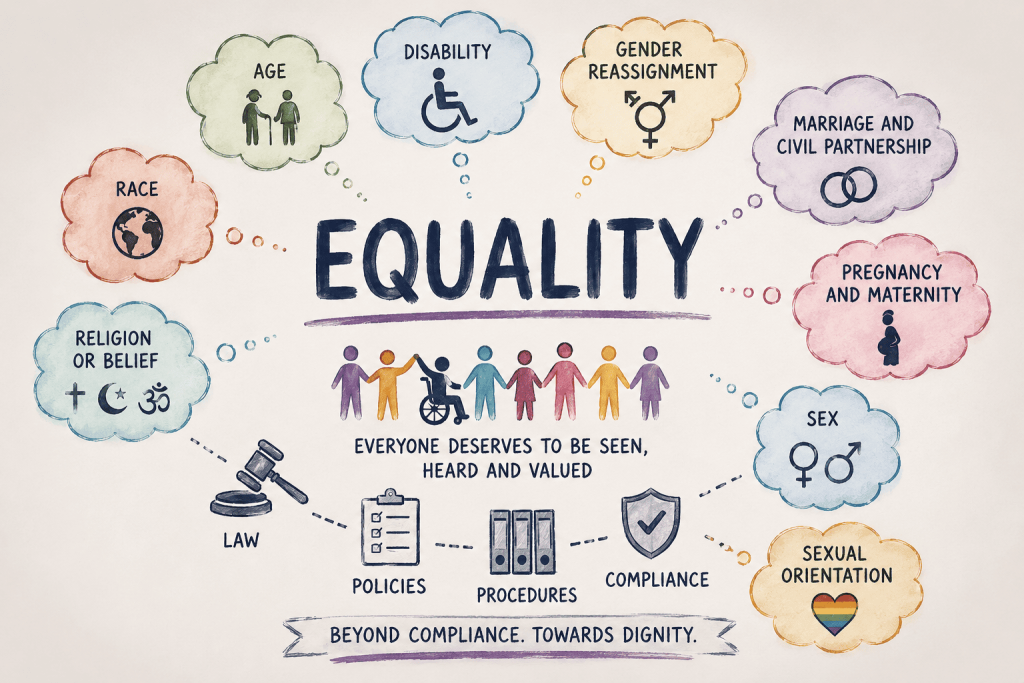
Usually, when we think about equality, we think in legal terms — protected characteristics, policies, compliance requirements. And those things matter. They create essential safeguards and establish standards that should never be compromised.
But equality in adult care is so much more than legislation.
In live-in care, we as carers are often the one constant in a person’s life, which means we are usually the first to notice when something feels wrong. This is why safeguarding in adult socialcare is such a crucial part of our role. It is our duty of care to support every individual’s fundamental right to live safely, free from fear, harm, or neglect. Whether you are a carer, family member, neighbour, or member of the wider community, safeguarding is a shared responsibility.
Working in social care means not only treating people with compassion and dignity but also understanding the legal framework that underpins everything we do. Every carer should know the law behind care — the legislation that protects both the individual receiving care and the person providing it.
You know what really gets me? When people talk about getting older, they always throw around numbers – like turning 70 or 80 is some deadline where everything falls apart. But working in live-in care has completely changed how I see all this.
When you live and work in someone’s home, the ability to “switch off” can be very challenging. Taking breaks in live-in care is not always straightforward — the person you’re looking after may find endless reasons why they need you right this minute. Sometimes it’s not even them, but an unusual sound in the house that makes you double-check all is well.
Person-centred care starts with a simple yet revolutionary concept: seeing the individual as a whole person, not just their care needs, their condition, or a task to be ticked off in the care plan. That means we, as carers, look past the medical or care needs and try to see the person in front of us. Each one of us has a whole life before we might need support, and we are still living it just as the individual we are looking after. Therefore, we as carers must take the time to discover their stories, what they value, and how they like things to be done, and then we can honour them as the unique individuals they are.
Let’s take a closer look at how we can make the individuals the centre of their care.
When I first came to the UK and started working as a live-in carer, I thought it would be temporary—just for a couple of years—before returning home or doing something different. That was more than a decade ago. What I didn’t realise then was just how live-in care changes the carer—not suddenly, but slowly, deeply, and in ways you only recognise with time.
When I decided to apply to become a live-in carer, I read one of those so-called guides about what to expect. It laid out the tasks and responsibilities clearly enough, but it didn’t prepare me for living where you work—how complex and emotionally demanding the job can be. Providing care while trying to maintain professional boundaries isn’t always easy. The truth is, we don’t just work with someone—we become part of their life.
When you become a carer, you’re stepping into someone else’s world at their most vulnerable time. Maybe their body isn’t working like it used to, or they’re scared about losing their independence—everything feels uncertain and different. Sure, you’ll help with the practical stuff, but really, you’re showing up for moments nobody wants to need help with. Times when keeping dignity intact feels like an uphill battle. And while trust builds in those small everyday moments, there’s something much bigger holding it all together—a carer’s legal and ethical duties.
I get this question a lot — usually followed by an awkward laugh. I don’t blame people for asking. Live-in care is one of those jobs that’s invisible until someone in your life needs it.
But the reality?
It’s like being a nurse, housekeeper, companion, advocate, and sometimes therapist — all rolled into one.